Metadata Providers
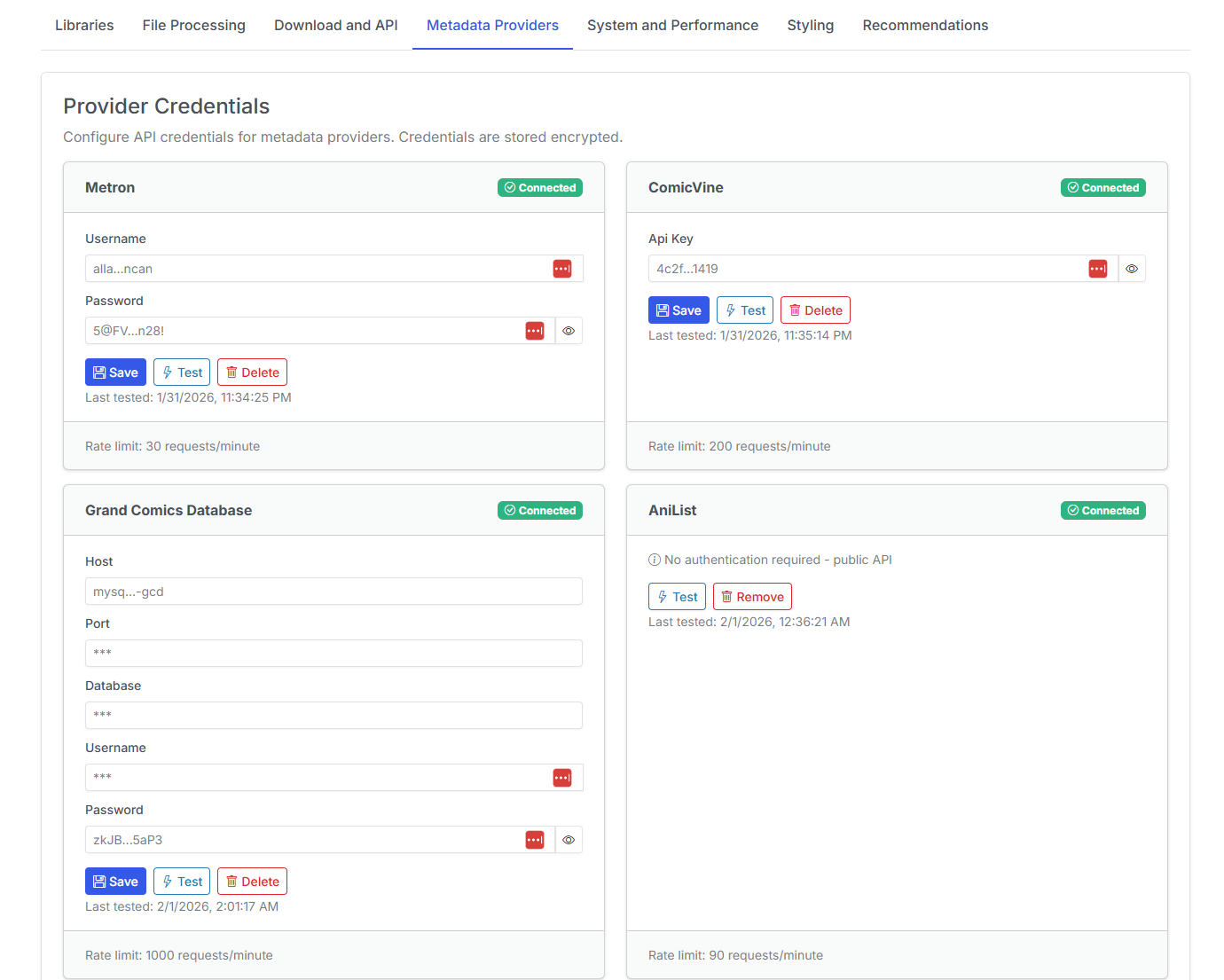
Metadata provviders and credentials are now configured and stored in the database. This allows you to add, edit, test and remove metadata providers from this page.
Configure MetaData Providers
For each section, enter the prompted credentials and click the Save button to save the credentials.
Once the credentials have been saved, you may click the Test button to test the credentials.
If the test is successful, a green checkmark will appear and say Connected in the provider header.
API Keys
Existing API keys and credentials are still in settings (config.ini) and will be removed in a future release.
Metron Authentication
New in v6.4
Metron supports API token authentication alongside username and password, and CLU now stops sending requests entirely when Metron rejects your credentials.
Choosing an auth method
The Metron card shows an authentication method picker with two options. Both are fully supported — the token is an addition, not a replacement.
| Method | What you enter |
|---|---|
| Username & Password | Your metron.cloud login. This is how CLU has always worked. |
| API Token (new in v6.4) | A token generated on your metron.cloud account page. Sent as a bearer token. |
If both are stored, the token takes precedence.
Save the credentials with the Save button . As of v6.4, saving Metron credentials verifies them in the same request, so you find out immediately whether they work. They're stored either way — refusing the save would strand you if Metron itself happened to be down.
Rejected credentials lock Metron out
Why this exists
A user mistyped their Metron credentials and CLU kept sending requests until fail2ban blocked their IP, and a Metron admin asked for it to be reported.
CLU couldn't tell a 401 apart from a normal miss, and the "is Metron configured?" check only tested whether the fields were non-empty. Meanwhile the call volume is large and repeating — the nightly series sync makes one call per mapped series across your whole library, the Weekly Releases publisher cache is re-warmed by a browser poll, and credit backfill, automap and post-download auto-tagging all loop too.
Metron's own API best practices are explicit: "Only retry on 429 and 5xx. Retrying 4xx errors (other than 429) wastes requests."
Now, the moment Metron returns a 401 or 403, CLU latches a block on all Metron traffic. Every subsequent call short-circuits without a network request, and no Metron client is handed out at all. The provider card shows the block with the reason Metron gave — for example, "Metron rejected the credentials (HTTP 401). Invalid token."
The block does not time out. A rejected credential doesn't heal on its own, so there's no automatic retry that would quietly resume hammering. Exactly three things clear it:
| Action | Clears the block |
|---|---|
| Saving your Metron credentials | Yes |
| Test succeeding | Yes |
| The Re-enable button on the Metron card | Yes |
| Waiting | No |
| Restarting the container | No — the block is persisted, so a crash-looping container doesn't resume hammering. |
Test always gets through
Test Connection is the one path allowed past the block — otherwise you could never prove you'd fixed your credentials.
Fixed alongside it
Story-arc pages built their own HTTP request and passed username/password unconditionally. On a token session both are empty, which strips the only credential and 401s every arc page. Basic auth is now only sent when there's a real username/password pair.
Five raw Metron calls that bypassed CLU's rate limiter entirely — one of them inside the Sync All loop — now take a rate-limit slot and respect the lockout like everything else.
Available Metadata Providers
Metadata providers and implementations status are listed below:
| Provider | Status | Description |
|---|---|---|
| Metron | Metron Comic Book Database | |
| ComicVine | ComicVine Database | |
| ComicVine (Local DB) | Local ComicVine SQLite database (requires local setup) | |
| GCD API | Grand Comics Database API | |
| GCD | Grand Comics Database (requires local setup) | |
| MangaDex | MangaDex Database | |
| MangaUpdates | MangaUpdates Database | |
| Bedetheque | Bedetheque Database (Future Implementation) |
Assign Metadata Providers to Libraries
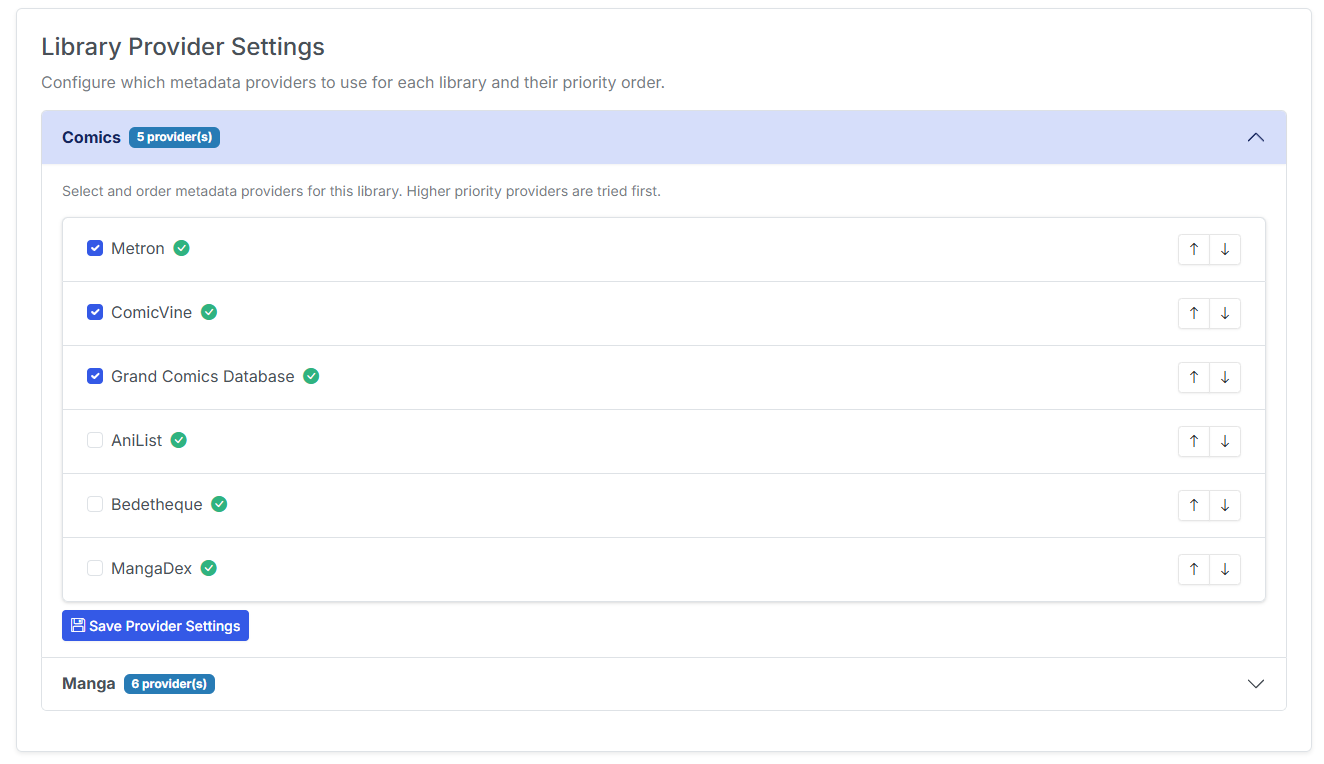
For each library, you can enable the metadata providers you want to use. Simply clcik the checkbox to enable the provider. Click the Save Provider Settings button to save the changes.
You can assing priority and preference for each library and provider combination. Click the up and down arrows to change the priority and preference.
When applying metadata to an issue or a folder, CLU will iterate through the providers in order of priority and preference and apply the metadata from the first provider that returns a result.
Metron credit roles
Metron's Script and Plot credit roles now map to Writer, so writers credited as "Script" (e.g. Jeff Lemire on Black Hammer) are no longer dropped from metadata.
Editor credits — new in v6.4
Metron's editorial credits now land in <Editor>. Metron spells these roles out in full — Editor, Executive Editor, Group Editor, Editor In Chief, Assistant Editor, Associate Editor — and CLU was matching role names exactly, so it found one name out of four and dropped the rest silently.
Editors are now matched on substring, the same way ComicVine already worked. Non-editorial titles Metron credits on the issue — President, Publisher, Chief Creative Officer, Designer — don't contain the word, which is what keeps them out.
This applies to newly tagged files and to any file the credit backfill repairs. Files that already carry credits but no <Editor> are not rewritten automatically — repairing those is a bulk re-tag with overwrite existing, not a backfill.
Re-tagging preserves what the new provider doesn't supply — new in v6.4
Applying metadata used to rebuild ComicInfo.xml from scratch, destroying every tag the new provider didn't have. ComicVine carries no genre data at all, so re-tagging a GCD-sourced file through ComicVine always lost its Genre. Tags the new metadata omits are now carried forward.
Several ComicVine credit defects were fixed in the same pass: ComicVine returns each creator's roles as a single comma-joined string ("penciler, inker") and CLU matched the whole string first-match-wins, so a creator landed in exactly one bucket and every other credit they held was discarded. editor, bare artist, painter, plot, finishes and translator had no bucket at all — and bare artist is very common. Web is now mapped, and Notes records the issue id rather than only the volume id, so files round-trip with comicbox and ComicTagger.